2020
The World of Trees, Plants, Fungi and Small Insects
## The Hidden Communication and Relationships of Trees
1. All the time, chemical alarm signals are buzzing around within the trees, through the air. Fungal networks around roots also allow them to carry warning signals. Chemical compounds and electrical impulses travel at the rate of ⅓ inch per second.
2. Fungal intermediaries within the rooting complex intermix many plant species.
3. In this apparent silence, it is a talkative world, warning, competing, co-habiting.
4. Colour and fragrance are invitations to insects, bees and caterpillars to work, pollinate and get their reward in return.
5. Within the same species of trees, fungi around roots carry out nutrient redistribution work from stronger to the weaker, providing a form of social security.
6. “A tree can only be as strong as the forest that surrounds it.” — Peter Wohlleben.
7. “A chain is only as strong as its weakest link.”
8. In heavy blooms, even wind helps pollination.
9. On a massive scale, trees produce huge amounts of pollen to be carried by bees, insects and wind.
10. Pollen fertilises the female flowers.
11. Male and female blossoms: Some trees have male and female organs in the same blossom.
12. A pollen grain landing on a stigma activates its genes. Through a tube developing from it, it moves down towards the ovary, looking for an egg, leading to the development of fruit and seeds.
13. Male flowers give off alluring aromas and colours, attracting insects to them. Later, the bees move to more sober female flowers, transporting pollen to them. The male pollen has to move to the female for procreation.
14. Trees avoid reproducing their own gene pools by interbreeding and getting pollen from other trees.
## Survival, Fungal Networks and the Secret Life of Trees
1. Normally, trees defend themselves by making their leaves excessively bitter for insects.
2. Over its reproductive age, a tree produces millions of nuts and seeds, all in the hope of keeping its genes alive. At the end of it, after a lifetime of fruit-bearing, if a single son or daughter thrives to reach adult status, it is called successful reproduction.
3. Cambium is the life-giving layer under the bark.
4. Trees scream at the ultrasonic level through crackling roots and vibrating trunks.
5. Fungi lie somewhere between plants and animals. Their cell walls are made of chitin, which is not found in plants and makes them a bit like insects. Unlike plants, they cannot photosynthesise and take organic nutrients to feed on living beings. Their underground web, the mycelium, probes for edible tissues.
6. Some fungal masses cover hundreds of hectares and are hundreds of years old.
7. Trees cooperate with fungal networks to optimise their water and nutrition intake. These webs connect with the webs of other trees, serving as agents of nutrient exchange and even alarm communication, such as during insect attacks.
8. For their service, the fungi charge doses of sugars and carbohydrates from trees.
9. Diversity is a safe voucher for security.
10. Wood-boring beetles and bark beetles hack away at the trees' life-sustaining cambium.
11. The trunk consists of long tubes for transporting water through a suction mechanism fuelled by transpiration, osmosis and capillary action.
12. A majestic banyan ageing gracefully.
## The Tree as a Living World
1. A normal human sheds around 0.05 ounces of skin cells every day. Around 10 billion particles flake off us every day, making about 0.7 pounds in a year.
2. Algae, moss and fungi on the old bark are like the mirrors of an old, old tree's soul. Decomposition.
3. An old tree's bark giving way to fungal growth.
4. Oak — a symbol of longevity and fortitude.
5. A dwarf tree, almost a shrub, in the tundra may take a century to grow one foot.
6. Trees and plants are Mother Earth's clothes. We are ripping them apart, forcing her into nakedness.
7. Peter Wohlleben: “An organism that is too greedy and takes too much without giving anything in return destroys what it needs for life and dies out.” So there is an inherent tendency to avoid overexploitation.
8. A tree has sugars, lignin, cellulose, water, carbohydrates and minerals. These add up to millions of calories.
9. Aphids, also called plant lice or greenflies, suck tree fluids, filter protein for their growth and expel much of the sugars and carbohydrates as honeydew.
10. Sap-sucking pests, leaf-eaters and bark peelers feed on different parts of trees.
11. Ladybugs feast upon aphids, while ants eat honeydew.
12. Midges, wasps, bacteria, fungi and caterpillars are among the many small organisms associated with trees.
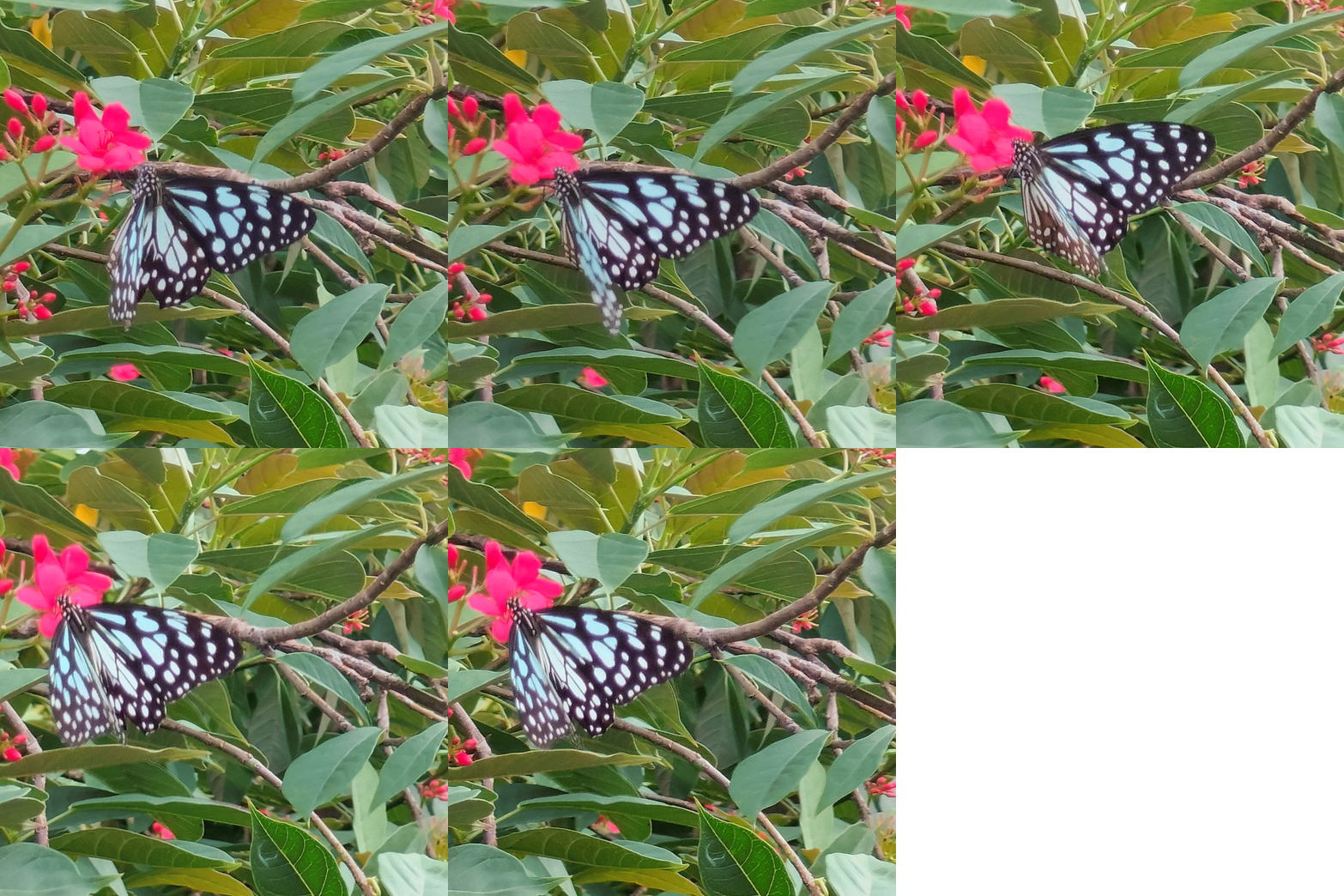
13. Butterflies, moths, flies, wasps and beetles are also part of this living world.
14. A growing plant's leading shoots are nibbled off, turning them prematurely aged, bent and bowed.
15. Fungus, mushrooms and tree stumps: Their rooting mycelium plunders nutrients and sugars from the tree's cambium, leaving mouldy wood.
## Photosynthesis, Defence and the Breathing Forest
1. Photosynthesis is the process of changing light and CO₂ into sugars.
2. Nesting cavities provide homes for creatures living in trees.
3. Pecking among wood to get beetle larvae.
4. Hermit beetles are not too eager to move around. They spend their time in a hole in a mouldy trunk.
5. Diversity ensures that one species does not take over.
6. Bracket fungus — possibly *HID* (fire).
7. Leaves are the solar panels of a tree.
8. Trees produce defensive compounds called phytoncides. These are antibiotic in character and keep their surroundings safe from threats by bacteria, viruses, fungi and insects.
9. Quaking aspens: Their leaves shake even in the gentlest breeze and expose both faces to the sun to photosynthesise at double the rate. In other species, photosynthesis takes place only on the upper surface, while the lower surface is normally used for breathing.
10. Flies feed on seeds, carrying the parent tree's genes to far-off places.
11. During drought conditions, the leaves get an extra waxy layer on the leaf surface. It slows down transpiration. Of course, with this cover, breathing becomes burdensome, but survival demands it.
12. Hoar frost: Plants covered under sugary frost.
13. Conifer forests contain germs in the air, so allergic people feel better in these forests.
14. In summer, trees release 29 tons of oxygen per square mile per day. A human breathes in 2 pounds of oxygen per day.
15. Marine air: Algae in salt water produce oxygen, which bubbles out of the water and compensates for oxygen deficits on landmass, especially during winters.
## Page 5 — Light, Colours and the Extraordinary Life of Leaves
1. Blue skies, bright sunshine: Trees convert sunlight, CO₂ and water into oxygen, sugars, cellulose and carbohydrates.
2. Why do we see different colours around us? Every object absorbs light differently and changes it into a different kind of radiation. The remaining wavelengths are reflected back and decide the colour we see.
3. The reflected light from leaves is, in fact, the unused spectrum of light which the chlorophyll cannot process. The uplift of our aesthetic sense is, in fact, the thrown-away portion of light.
4. Young leafy shoots are red. Why? Their soft tissue has a sunblock called anthocyanin. It blocks UV rays to protect the soft leaf sprouts. With the leaf's growth, anthocyanin is broken down by an enzyme.
5. “Tree blood” — water and nutrients move from roots to leaves at a rate of ⅓ inch per second.
6. Kichwa of Sarayaku, Ecuador: “Forests are the most exalted expression of life itself.”
7. The sunlight travels 93 million miles to reach your eyes. Photons, the packets of energy, carry light.